Sunday, November 10, 2013

Bermudagrass Nightmare

It has been quite awhile since my last blog post - over a year.  I'm hoping to get back in the swing of things and have much more frequent posts on my Texas Garden.

This summer in Texas was a brutal one.  Between the heat, drought, and my multiple travel excursions for work and play (California, Minnesota, Brazil, Turkey, Bulgaria, Poland and the UK), my garden was extremely neglected.  On top of that, one of the worst possible things happened while I turned a blind eye to my veggie beds - BERMUDAGRASS INVASION!

You can barely even see the outline of the veggie beds, or where the mulch path use to be.


Bermudagrass is a common grass grown here in Central Texas, because it is so invasive and will fill every part of your lawn by multiplying through seeds and the extensive underground root system and rhizomes. It does well on limited water, poor soil, and in intense heat, making it perfect for the Central Texas growing conditions.  However, I did not do a very good maintenance job, and once the Bermudagrass found it's way into my nutrient-rich raised vegetable beds, there was no stopping it from a complete takeover.

I did try multiple times during the summer to till and weed the Bermuda grass up in the beds, only to have it grow back with more vengeance. After a couple of tries, each taking 4 hours or more, I gave up on trying to maintain the grass by just tilling and weeding.

You will notice that the two veggie beds that get full sun have the worst Bermudagrass invasion, since Bermudagrass thrives in the full-sun, but doesn't do as well in the partial to full shade.


Finally, as part of my birthday present in October, my thoughtful husband decided to help me tackle the mess.  With some insight from his colleague, who does some landscaping on the side, he first pulled up all the mulch and weed block that had been laid down around the beds.  This was originally put down to BLOCK the Bermudagrass and other weeds from the beds.  However, I have now learned that mulch does not stop Bermudagrass.  If anything, it actually acts as a perfect place for the grass to take root and grow.


Next, he tilled up all the roots in the beds as well as all the roots that had grown UNDER the weed block around the beds and pulled up and threw away as much as possible.

Then, he laid down several yards of crushed gravel around the beds.  His friend informed him that it will be much more difficult for the grass to grow over or under the crushed gravel than it was with the mulch.  This gravel will then be packed down by tampering the crushed stone and we will later put some more decorate stones or pebbles on top.


There will then be more work in store for me next spring and summer to maintain the Bermudagrass from getting out of hand again.  Fall and winter is the dormant season for the grass, so I will need to wait until the growing season next year to fully get rid of the remaining rhizomes and seeds that still remain in the beds.  Other than tilling and weeding, I plan to try solarization (using plastic sheets to mulch the beds and kill the seeds and roots with high solar radiation).  If that doesn't do the full trick, I might need to take an inorganic approach and spray the beds thoroughly with an herbicide like Round Up.  I will try to exhaust all organic methods first.

Here's to hoping the new gravel borders, tilling, and eventual solarization works to KILL THE BERMUDAGRASS!!

Sunday, July 15, 2012

More Rain and Today's Harvest

It has been about seven straight days of rain here in Central Texas, and the garden is loving it - not to mention all the wildlife around here that is enjoying the wet weather and break from the Texas heat.  It has rained so much that there is now a pond in the park behind our house!  It is actually a retention pond for instances such as this, but most of the year it is completely dry.


The wet weather has really been making the garden grow.  Today I harvested a large bunch of basil that I have growing next to my tomatoes.  I cut the basil back, but left enough of the stems so that it will grow back and I can harvest it again in a couple of weeks.  Now is time to make a little pesto to put in pastas and on chicken sandwiches. 

I also pulled one radish from the garden today.  It looked picture perfect, but wasn't the best tasting in my opinion.  It was definitely fresh enough, just too-radishy.  I think I had them in the garden a little too long, so they got overwhelmingly flavorful.  I also planted radish during the Texas summer, which is not the suggested season for them.  They prefer the cooler spring and fall months.  I think the heat made them extra potent and a bit too much for me.  I'll be planting radishes only in the spring and fall now.


I was able to plant some seeds indoors on my new grow shelves as well.  Yesterday I planted:

  • Fruit/Veggies
    • Eggplant - Early Long Purple (Martha Stuart Organic)
    • Eggplant - Black Beauty (Ferry-Morse)
    • Watermelon - Tasty Sweet (Burpee)
    • Pablano Pepper (Ferry-Morse)
    • Pepper - California Wonder 300 TMR (Ferry-Morse)
    • Tomato - Supersweet 100 VF Hybrid (Ferry-Morse)
    • Swiss Chard - Fordhook Giant (Burpee)
    • Swiss Chard - Ruby Red (Burpee)
  • Herbs
    • Sweet Basil (Burpee)
    • Spanish Cilantro (Burpee)
  • Flowers
    • Marigold - Best Mix (Burpee)
    • Morning Glory - Tall Mix (Burpee)
    • Lupine - Russell's Hybrid Mixed Colors (Ferry-Morse)
    • Painted Daisy - Giant Mixed Colors (Burpee)
Note - I soaked the morning glory and lupine seeds for about 18 hours before planting to soften the hard seed shells to hasten germination.

Saturday, July 14, 2012

Indoor Grow Shelves

My most recent garden project was setting up indoor grow shelves.  These shelves will come in handy for starting my garden seeds inside when it is either too cold outside (January), or when it is too hot outside, like right now.  I tried several times to get some tomato, pepper and eggplants to grow from seeds outside, but I think it was too hot for them because the seedlings kept wilting.


I also tried starting watermelons and cucumbers from seeds multiple times.  The heat didn't bother them, but I noticed that bugs were chewing through the delicate cucumber stem and that the mockingbirds were pulling my watermelon sprouts right out of the ground.  The grow shelves should help me get the plants established before putting them outside.


To set up my grow shelf, I bought:
  • Whitmor 4-tier metal shelving unit ($65)
  • 3 4-foot 2-light T8 fluorescent shop light fixtures ($60)
  • 6 4-foot T8 fluorescent light bulbs ($30)
    • 4 Philips Daylight Deluxe (32 watt, 2750 lumens, color temp 6500K)
    • 2 Philips Soft White (32 watt, 2950 lumens, color temp 3000K)
The daylight bulbs produce blue light, which are needed for the seedlings to grow.  The soft white produces red spectrum light, which the plants need for flowering.  Blue light is more important for starting seedling indoors that will later be transplanted outside, but I read that having a full spectrum of light (blue and red) is good for the seedlings.  I'm trying a little experiment and I have one of the shelves with only daylight (blue) lights.  The other two shelves have one daylight (blue) and one soft white (red) lights.  I'll see which one the seedlings tend to do better under and will adjust my lights accordingly to use the best light for my plants.


Monday, July 9, 2012

Finally Some Rain!

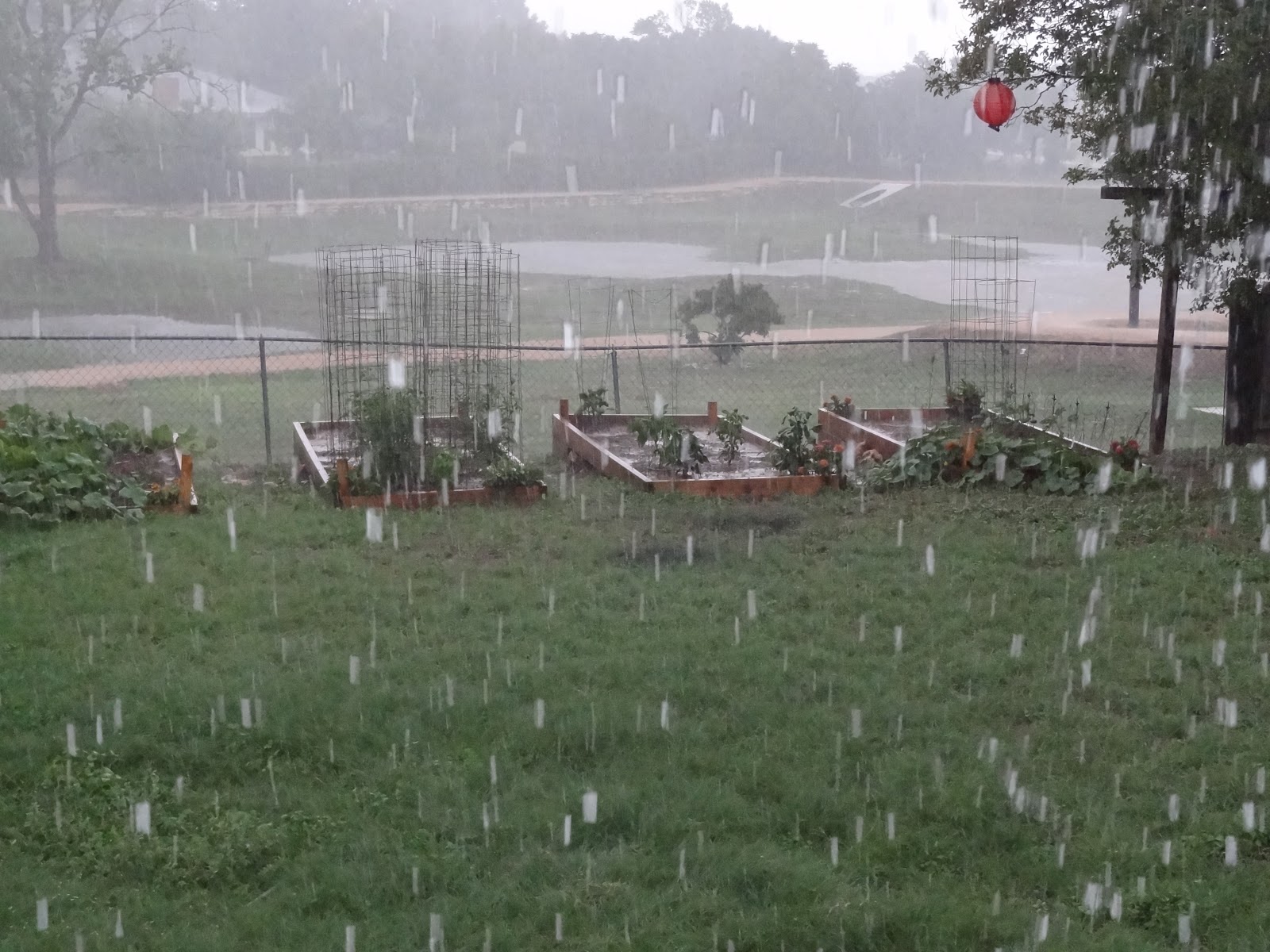
We got a break in the 100+ degree Texas weather and a relief from the dry spell, finally!  It rained maybe and inch between last night and today, which isn't a lot by most standards, but it has become a rarity in Central Texas.  My yard and garden are definitely loving it.  I just hope we continue to get rain over the summer.  A nice big thunderstorm would be more than welcome too.  The rain is hard to see in the picture, but it happened, I promise!


Sunday, July 8, 2012

Shade for the Hydrangeas

About a six weeks ago, I bought two Endless Summer Twist-n-Shout hydrangeas.  I was told by a random customer at Home Depot that they do really well in the shade.  But my internet research said that I should give my plants at least several hours of morning sun for them to bloom properly.  So, I planted them along the fence in my backyard that receives morning sun and afternoon shade.


Apparently, the spot I selected received too much morning sun and not enough afternoon shade, because just a couple of days after planting, my hydrangeas were looking very sad and wilted.  I realized I needed to quickly move them to another part of the yard with more shade, or they would die.  I again recruited the biceps of my husband to dig two new holes for me (again, the Central Texas ground is a beast to deal with all the rock) in the back corner of our lot, next to the canna lilies, where I thought there would be more shade from the trees that tower overhead.


Several weeks have gone by, and I realize that my hydrangeas are still receiving too much sun. I desperately needed to get them in some full shade, or else they will wither up and die on me.  Unfortunately, it is a treasure hunt to try and find a soft patch of ground that isn't filled with boulders two inches above the surface.  Not to mention, it has barely rained in Central Texas this summer, so where there is actually top soil, it is nearly as hard as the rock a few inches below.


Desperate to save my hydrangeas, I got the idea to get the hose out and let it run for 30 minutes in the specific spot I wanted to plant my hydrangeas, to help loosen the soil (good thing we aren't on water restrictions...yet!).  Low and behold, the plan worked!  However, I also needed a little additional help from my handy pick-ax that I recently purchased (a must-have for any Central Texas gardener to get through the rocky terrain).  The mix of the softened ground and the pick ax allowed me to dig the size holes I needed to transplant my hydrangeas.  Not to mention, I was able to dig the holes all by myself, even with my puny muscles.


The hydrangeas definitely show signs of taking a beating from the brutal Texas sun, but they also look like they will be able to jump back to life in no time.  I just hope I picked a shady enough spot this time.  We will soon find out!  And let this be a lesson to me to always heed the advice of the home gardeners testimonies over the internet recommendations.

Saturday, July 7, 2012

Hummingbirds

I'm SO excited!  I saw not only one, but TWO hummingbirds in my backyard today flitting around together.  I also saw them many times today, coming to the hummingbird feeder at least every hour, if not more.  At one point, I was just two feet away from the hummingbird!  I think they were Central Texas Black Chinned Hummingbirds.  They definitely did not look like ruby-throated hummingbirds.  They let me take a couple of pictures of them.


While the hummingbirds seem to like the standard hummingbird feeder, to make sure they stay around, I wanted to give them a few more options, so I planted some flowers under my hummingbird feeder that are suppose to attract hummingbirds.  I planted some lantana and some coneflowers.  The butterflies should like this new flower garden as well.


Eventually, I plan to add some other flowers to this small flower garden that attract butterflies and hummingbirds.  I plan to plant some columbine, lupine, and daisies later this fall.

Friday, July 6, 2012

Okra

I've never grown okra before, and I've only eaten it once or twice.  But, it seems to be one of the vegetables that does well in the hot Texas sun, so I thought I would try growing some in my garden this year.  


On May 20, I planted some Clemson Spineless okra seeds directly into one of my raised garden beds, spaced to eventually have four plants planted one foot apart.  A few of the seedlings died, or were uprooted by some of the notorious Northern mockingbirds (Texas' state bird) that fill my backyard, but I've ended up with at least one strong plant per square foot, four total plants.  The plants seem to grow very slowly.  I think I might have planted them a little too late in the season.


I got impatient, so I went to the nursery and bought two older seedlings so that I wouldn't have to wait as long for some produce.  The plants were very tall and skinny with only a few leaves.  I think the nursery might have pinched most of the leaves to stimulate the plant growth.


I found a pretty okra flower on one of the older seedlings from the nursery a couple of weeks ago.  It was very cute, but only boomed for a few hours one morning,  I haven't seen any other flowers on the plants yet.  I'm hoping to get more soon so that I get more vegetables.


Right now, I just have one okra on each of the larger plants.  I'm not sure why there aren't more right now.  I will need to do some more research to find what causes this, and how I can stimulate more flowering.  I also will need to learn when the right time will be to harvest these funny veggies, not to mention find some tasty recipes to use them in.