Showing posts with label monarch. Show all posts

Sunday, November 9, 2014

Wildlife - November 2014

I'm a few days late to joining into Tina's Wildlife Wednesday posting - that's what business travel will do to you, but I wanted to make sure to post my pictures from wildlife in my garden this past month.

Butterflies & Caterpillars
The highlight of the wildlife in my garden have been all the caterpillars and butterflies.  It gives me a sense of pride to know that I'm providing enough host and nectar plants to support these beautiful creatures in my garden.  I hope that I can continue to grow the variety and number of caterpillars and butterflies that I can host.

Monarchs
The monarchs have definitely been the stars of the garden this month.  I probably had around ten or so monarch caterpillars taking up residence on my milkweed.


After learning that only about 10% of monarch caterpillars make it to adulthood, I took matters into my own hands and reared three caterpillars to adulthood.


The bittersweet day came when I had to release my monarchs back into the wild.  I hope they will return year after year with their future generations.


So far, I haven't gone a day (except for one day when it rained) without seeing my monarchs in the garden.  Just yesterday I saw three of them hanging out on the milkweed.  I wonder if they are the same three that I raised?  It will be getting cold soon and they will be making their way to Mexico, so I'm savoring the moments that I get to see them flit around the garden.


Eastern Black Swallowtail
I also had a handful of swallowtails munching on my parsley this past month.  The caterpillars look like they are a different species than the ones that visited earlier this year.  These guys have more black than green on their bodies.  The mother swallowtail butterfly was too quick for me to take any snapshots, but here are a few pics of the different caterpillar instars that I was able to capture.

Second instar:


 Third instar:


Fourth instar:


I took in one of these guys to see if I could rear him to adulthood like I did for the monarchs.  I'll share my experience on that in a later post.

Painted Lady
I didn't see nearly as many painted ladies as I did monarchs or swallowtails, but she was still a welcomed visitor.


Queen Butterfly
I have a handful of Queens in the garden.  They can easily be confused with Monarchs, but a few ways I can tell that the butterfly is a Queen and not a Monarch is:

1.) Queens feast on the Gregg's Blue Mistflower while Monarchs prefer the milkweed
2.) When they open their hindwings, Queens don't have the black stripped veins like Monarchs
3.) Queens are a bit smaller in size than Monarchs


Unknown
I haven't yet figured out what this little guy is.  Any thoughts?


Birds
I haven't snapped too many pics of birds this past month.  I've had fewer than normal at my feeders.  It is just the sparrows and doves that are generally hanging out at the feeders right now.  That probably means that the seeds and berries are plentiful right now, so the birds don't have to resort to my feeders.  While I'm happy they are finding other food sources, I look forward to their return to my feeders in a month or so when fresher food is more scarce.

Eastern Bluebird
I did see a few Easter Bluebirds, at least as far as I can tell.  Their color wasn't very vibrant, so it might have been several females that have more muted colors.  Or, maybe it was some other species that I just can't place.


Pests
While there have been a lot of beautiful and beneficial insects to my garden this past month, there have also been quite a few pests.

Cutworms
I found probably around 100 cutworms wreaking havoc on my cold weather vegetables - the nerve!


What did I do to get rid of them, you may ask?  I looked under every single leaf and picked them off one-by-one...then squashed them.  It was definitely effective, but not very efficient - so if you have any other organic solutions to preventing and killing cutworms in the future, I'm all-ears.


Here is the aftermath on my broccoli.  Hopefully I got rid of at least most of them so that the new leaf growth won't look completely munched through.


Squash Vine Borer
My arch nemesis is the squash vine borer.  I love squash.  It is delicious and (usually) easy to grow.  But the squash vine borers do not want me to have my squash.  No - they prefer to lay their eggs on my squash and have their larvae eat my squash vine from the inside out - bastards.  I've tried picking off all the eggs that I could find as well as cutting the larvae out of the vine, all with no luck.  The borer still wins and I end up with little to no squash.


Has anyone else beaten out the borer?  If so - please share your tricks!  I want to grow squash so badly, but if I continue to have these challenges with the borers, it is not worth the effort and space in my garden to try time and time again.


Red Wasps
My last group of unwelcome visitors for the month were red wasps.  They built their nest in the ceiling of my front entry-way porch - a nice cozy and cool spot for them out of the way of the elements.  Of course, I didn't want my welcomed human guests to get a nasty sting when they come to visit me, so the wasps had to go.  They got a decent spraying of a very non-organic pesticide which did the trick.  Bye-bye wasps.  If only the squash vine borer was as easy to get rid of.


Thanks for stopping by to check out the wildlife in my garden.  Be sure to visit My Gardener Says to see even more posts on garden wildlife.

Thursday, October 30, 2014

Save the Monarchs! (Part III)

It seems only right that my 100th blog post capture a momentous occasion...the emergence of my monarch butterflies!  Plus - what better way to celebrate Halloween than with some festive black and orange butterflies?

In my earlier posts, I logged my adventure of bringing three monarch caterpillars into my home to rear to adulthood.  As of last week, 10/23/14 (and my birthday!), all three of my monarch caterpillars had emerged from their chrysalis!

10/22/14 (Day 17) - The first butterfly hatches from his chrysalis.  Unfortunately, this happened while I was at work, so I did not witness him emerging from the chrysalis, his scrunched up wings, and the process of his wings drying and pumping blood to the wings to give them their full shape for flight.


How do I know it is a "him," you may ask?  It is really quite simple.  Male butterflies have black scent pouches on their hindwings.  The veins of their wings are also much thinner than that of their female counterparts.


Before releasing my grown up butterfly, I spent a few moments getting acquainted.  Their legs are really quite sticky, making it a bit tricky to remove him from my hand once he was latched on.


10/23/14 (Day 18) - My remaining two butterflies emerged the following day... and on my birthday!  What a sweet birthday present from nature!  One was a strong and energetic female (notice - no scent pouches on the hingwings and thicker veins).


The third butterfly was a male (hindwing scent pouches and thinner veins again).  He was the weakest of all three.  Unlike the other two, he didn't immediately try to fly away and his wings looked a little off kilter.  I kept him around in the habitat for an extra day, thinking he needed a little more time to dry his wings or something.  Unfortunately, I think he was just born not in the most tip-top shape.


It was then time to release my precious darlings into the wild.


They took a liking to the Gregg's Blue Mistflower.  Hopefully, they will stick around the garden until their migratory trip to Mexico.  I understand they usually stay within 200-300 yards of where they were born.


I'm so proud of my Monarch butterflies, and really hope that I gave them a better chance at life and at increasing the diminishing population of Monarchs in the country.  It was a fun (and pretty easy) process to rear the Monarchs, so I encourage you to try it as well if you find Monarch caterpillars in your garden... and assuming you have plenty of milkweed to share.  It is bittersweet to see them fly off and leave home, but hopefully they will return to the garden with future generations of Monarchs.  Every time I see one in the garden, I wonder if it was one of my "pet" monarchs.


For now, I'm left with an empty monarch chrysalis on a milkweed plant.

Tuesday, October 21, 2014

Save the Monarchs! (Part II)

A couple of weeks ago, I took in three Monarch caterpillars with the hopes of raising them to adulthood.  Here is a look at how they have been progressing under my care:

10/10/14 (Day5):  In the evening, I checked on my baby caterpillars and there wasn't too much movement.  I checked on them an hour later before I was about to go to bed and found one of the caterpillars started to form the "J" shape right before it starts to pupate!  You can even see his silk-mat.  They hang in this shape for about a day before they shed their skin for the last time as a caterpillar.  Unfortunately, I had to leave town mid-day the following day, so I did not get to witness the final skin shedding of the metamorphosis.


10/11/14 (Day 6):  I had to leave town and was going to be away for a few days.  I still had two caterpillars in their fifth instar and didn't want them to starve on old milkweed while I was away, so I bought a small potted milkweed plant at my local nursery and put that in the butterfly habitat, hoping it would be sufficient for any remaining munching my little guys would need to do.


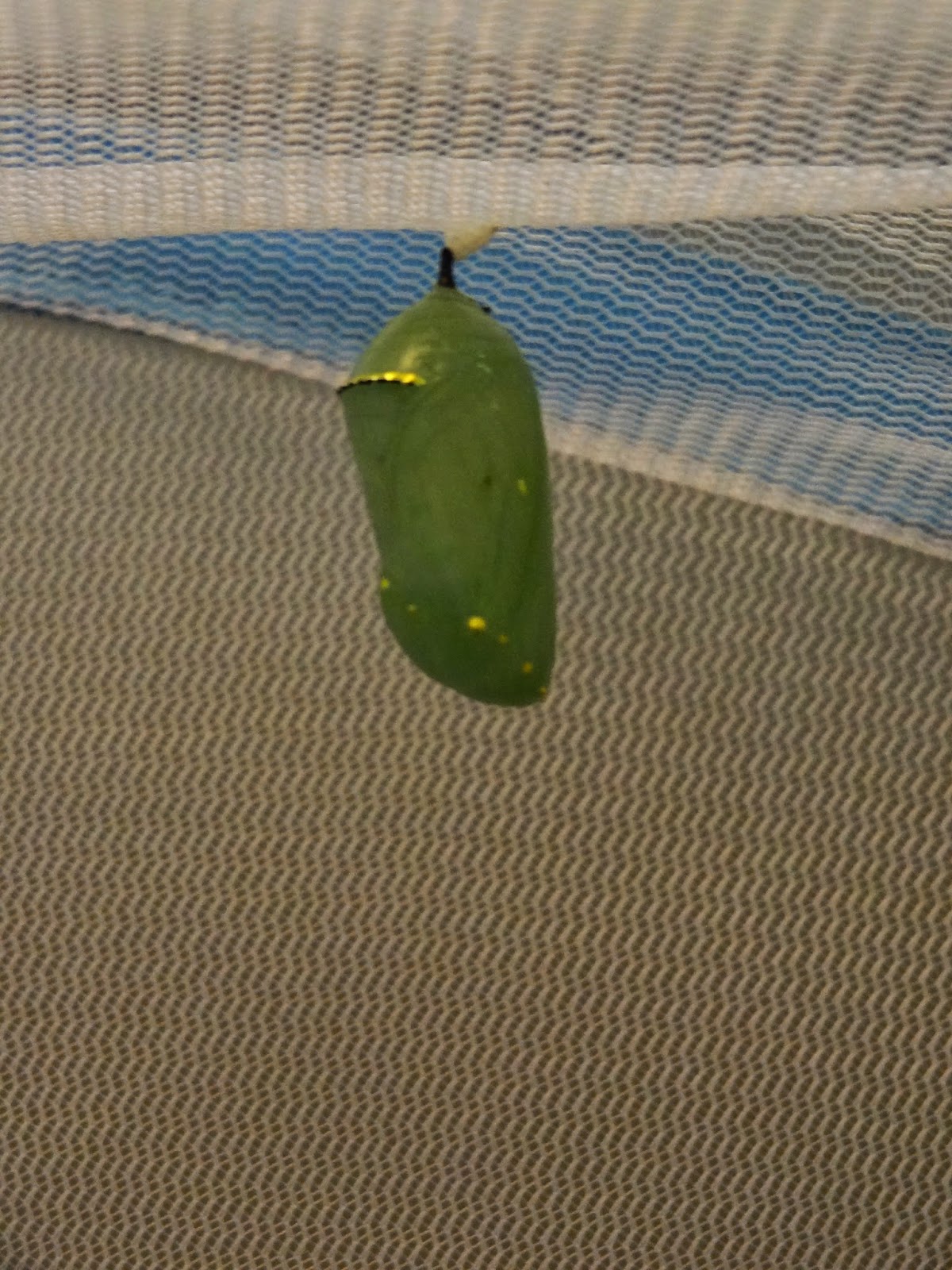
10/13/14 (Day 8):  I returned from my weekend trip to find all three of my caterpillar babies in their chrysalises.  I was in awe of the beauty of the little green jewels, even encrusted with flecks of gold.

Chrysalis #1 - This was the same guy that was forming the "J" in the Day 5 picture above.  Crazy what a difference a couple of days makes!


Chrysalis #2:  This guys traveled up to the very top of the butterfly habitat to form his chrysalis.  You can see the flecks of gold, and even make out the faint pattern of the monarch wings.


Chrysalis #3:  Can you find him?  He is camouflaged quite nicely.  I'll give you a hint - look in the middle of the picture.  See him there?  Now, I just need to play the waiting game for about 10-14 days before my butterflies emerge!


10/21/14 (Day 16):  It has been at least 8 days since my monarchs formed their chrysalises.  I can tell that the chrysalises are becoming more translucent, so we are getting closer! You can make out the black and orange colors, and even the white spots on their wings! Probably just a few more days until they emerge!


Friday, October 10, 2014

Save the Monarchs! (Part I)

A few days ago, I posted about how I had multiple monarch caterpillars feeding on my tropical milkweed.  I think I counted up to SEVEN monarch babies on my milkweed last Sunday.  I was so proud of my babies and how I was helping to re-establish the monarch population.  But then Monday came, and I only found two caterpillars.

WHAT HAPPENED TO MY BABIES?

Nature.  The circle of life. Doomsday for the monarchs.

Apparently the resident birds found the new monarch caterpillar buffet and were coming back for seconds.

It just so happens that same day, I found out that monarch caterpillars only have a 10% survival rate in the wild.  My mom also happened to read my blog post and told me to bring the caterpillars inside, IMMEDIATELY.

Here I was, proud that I had done my part to help the monarchs.  I of course thought that it was my part to just plant the milkweed host plants and let nature run its course.  I figured a couple caterpillars may be lost, but that overall, I would end up with a kaleidoscope of butterflies (yes, that is what a group of butterflies is called) by the end of the month.  Apparently, I was wrong.  It wasn't just enough to plant the host plants for the butterflies.  To help this endangered species, I needed to bring the caterpillars inside and foster them to adulthood if I wanted them to have any chance of survival.

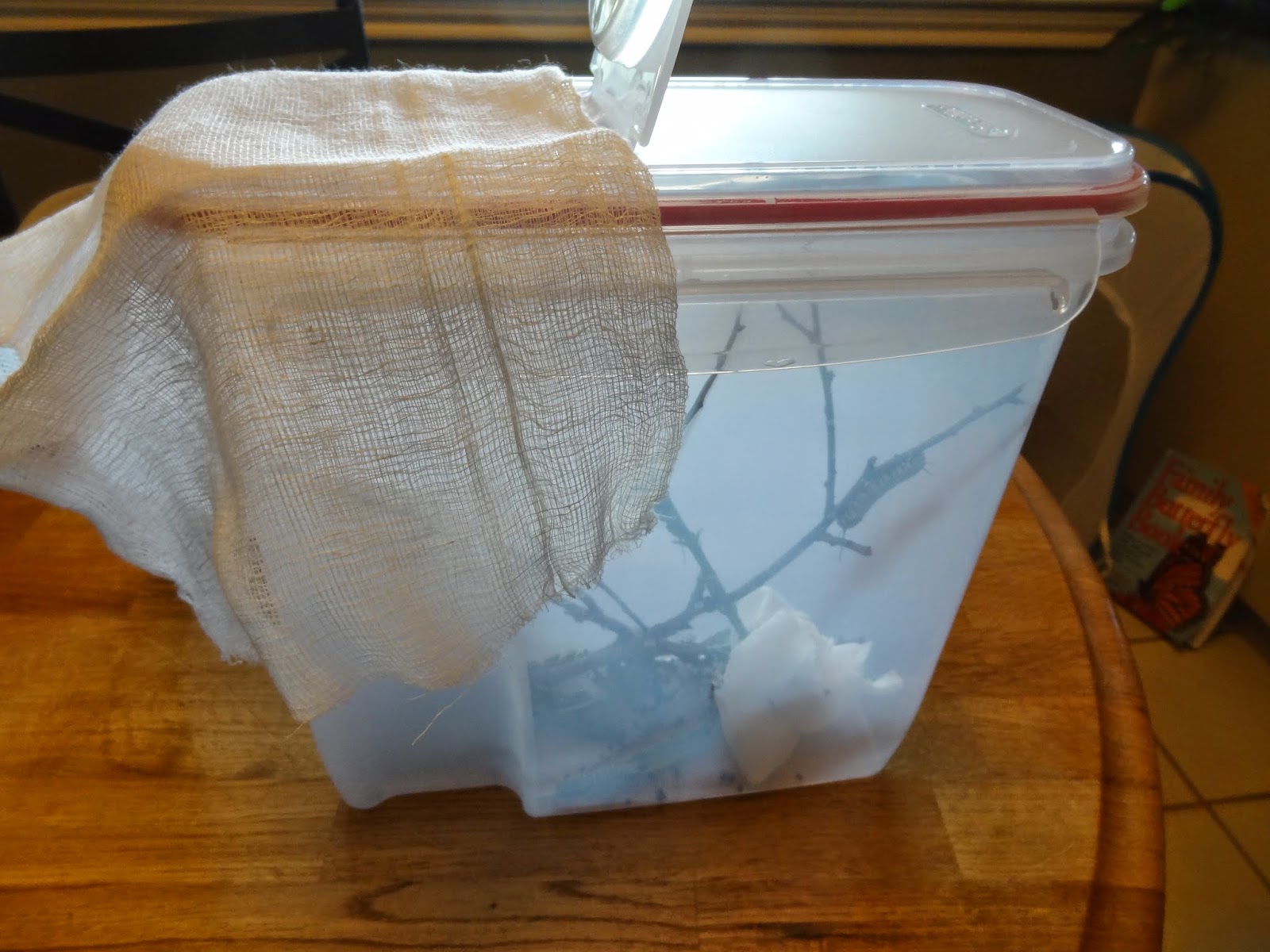
So, I quickly ran out and collected the remaining caterpillars.  All two of them.  I searched online and found the basics I needed to make a habitat for them.  Here is what I ended up with:


  • Plastic container (I used a cereal tupperwear container)
  • Cheesecloth for a ventilating cover
  • At least one stick for each caterpillar
  • Fresh milkweed leaves
10/6/14 (DAY 1):  I placed the two little guys in their new habitat.  They didn't do much moving around the first day.


10/7/14 (DAY 2):  I found another caterpillar outside (YAY!) on the milkweed and brought him in.  The other caterpillars had eaten some of the previous day's milkweed, but I could tell the leaves were starting to dry out and the caterpillars were searching around the top of the container, as if looking for newer and fresher milkweed.  So, I gave it to them, this time, providing a full sprig of milkweed and wrapped the stem in some damp papertowel, to hopefully keep the leaves fresher, longer.  The babies seemed to like it.


10/8/14 (Day 3):  I received some supplies in the mail from my mom - a collapsible butterfly habitat that is large enough to raise many butterflies, as well as place a whole potted milkweed plant (if I wanted), as well as a butterfly book guide on how to rear butterflies.  My momma is soooo thoughtful!  These were actually hers, as she and my little sister raised some butterflies a couple of years ago.  Since it is starting to freeze in Wisconsin, she said she won't need these for awhile.


 I put some newspaper in the bottom to catch the frass (a.k.a caterpillar poop) and make cleanup easier.  You need to clean the frass out every couple of days, otherwise the caterpillars may eat some of it and get sick and die.  I don't want that.  I also put in some bigger sticks and some nice, fresh milkweed.


I think they like their new home!


TO BE CONTINUED...

Saturday, October 4, 2014

First Monarchs!

They are here!  The Monarchs are here!!!  At least, one Monarch is here.  I saw her for a brief moment flitting around the garden.  I was able to snap a picture, but it wasn't the best quality because she didn't hold still for more than a second...but I needed proof that I actually saw her! ;-)


And now I have at least FOUR Monarch babies hanging out in my milkweed plants.  I'm not sure if two of these guys were the same ones that nibbled my other milkweed to the ground, or if these are their siblings.  But, I counted at least four separate Monarch caterpillars on my milkweed today.


This guy is the biggest, probably 2.5-3.0 inches long and nice and plump.


This one is the second largest - a little shorter and a little skinnier than the first.


Belly shot


Then, there are these little guys.  At first, I only thought there was one little one, but as I followed him throughout the day, I noticed he had a buddy.


The top guy is probably just short of one inch long and the other little guy is about 1/2 to 3/4 of an inch.  Pretty tiny, no wonder I almost missed them.


This is what my milkweed looks like now.  With four monarch caterpillars chomping away at them, I expect them to be picked clean once they enter their chrysalises in a couple of weeks.  We'll have to wait and see.

Wednesday, October 1, 2014

Wildlife Wednesday - October 2014

I'm excited to share the wildlife that has visited my garden this past month as part of Tina's Wildlife Wednesday over at My Gardener Says.

The gulf fritillary have been hanging around the garden a lot, and are especially loving the zinnias right now.


I'm also 90% sure that I saw a monarch flitting around the garden this week.  She didn't stop to let me take her picture, but it made me so happy to see that my garden was attracting the lovely and endangered creatures.  HOWEVER, I did find these little guys nibbling my milkweed to the ground:


MONARCH CATERPILLARS!  2 of them!  At least, as far as I can tell based on my quick internet search.  At first, I was a little miffed that they were stripping the milkweed bare, but then I figured that that is what they are there for, caterpillar food.  But once I found out they were most likely monarchs, I was so HAPPY they were eating the milkweed.  Anything to help them grow big and strong and multiply.


While digging in the veggie beds to do some fall planting, I found this guy.  Anyone know what he is?  Maybe a moth larvae of some kind?  Friend or Foe?


Seems like the aphids found the new butterfly weeds.  Lucky for me, the ladybug found the aphids.  These milkweed plants really do attract a gambit of wildlife.


As I was watering the Turk's Cap, this leaf-like grasshopper thing popped out of the plant.  With further research, it looks like he is a Greater Angle-Wing Katydid (Microcentrum rhombifolium).  Pretty interesting looking.


Then there are these guys - cactus bugs - which are having there way with my prickly pears.  They are leaving these ugly spots on the cactus.  Anyone have any good recommendations on how to get rid of these foes?


 The honeybees are loving the autumn sage that is in full bloom.


And then there are the regulars... like this Carolina wren.


And these lesser goldfinches.


Thanks for stopping by.  Be sure to stop by Tina's blog for more gardeners' wildlife recaps.